"Twenty years, one question: How do you stop guessing, compete against luck, and build what actually works (and is worth building!)?"
I am a mission-driven entrepreneur, operator, and educator. I have spent my career building companies and organizations—mostly venture-backed startups in Silicon Valley, including building an applied deep tech AI company ahead of the ChatGPT moment and navigating that market shift as a founder, operator, and CEO. I've had some wins and losses to date. And lots of in betweens.
My Entrepreneurship Scorecard
- The Exits2 successful company exits
- The Failures1 major public failure
- The Capital$155M+ raised from top-tier venture capitalists
- The Grants$5M+ in competitive government grants
- Current RoleExecutive Director of the Center for Applied Entrepreneurship & Innovation at Mays Business School, Texas A&M University
My Journey: From Theory to Scars
I. The Jerusalem Ornament Hustle (The Early Spark)
I grew up as the son of an Arabic linguistics professor. Every five years, my family would pack up and live in the Middle East for a year. That environment made me an idealist and an optimist early on. At 12 years old, my dream was to solve the Israeli-Palestinian crisis.
But I was also a doer. At that same age, I imported olive wood Christmas ornaments from Jerusalem and sold them door-to-door in the US, making thousands of dollars. My dad, an academic rather than a businessman, looked at me and said, "I think people like you go to Stanford Business School." From that moment, my life plan was set: go to business school and build companies in Silicon Valley.
II. Obsession with Customer Discovery & HBS
Before I ever reached business school, I became obsessed with Steve Blank's customer discovery methodology. As an undergraduate founder trying to make sense of building, a mentor put Steve's The Four Steps to the Epiphany in my hands.
It was a revelation. It taught me that startups are not smaller versions of big companies; they are search processes. I became a dedicated student and practitioner of the Lean Startup movement, obsessed with the idea that founders must get out of the building and test their assumptions.
I ended up taking my academic path to Harvard Business School. I arrived at Harvard already as an experienced builder. During the 2008 crash, I had bypassed traditional jobs to start a renewable energy non-profit, raising significant funding and operating across 15 western states.
At HBS, I had the privilege of studying under Clayton Christensen. His classes and mentorship began to reshape how I saw the world, teaching me to look at market dynamics through the lenses of disruptive innovation and Jobs-to-be-Done (JTBD).
During my time at HBS, I was also deeply influenced by Jeff Bussgang. His guidance served as a major catalyst for my path into founding a technology venture, and he has continued to be a trusted mentor and inspiration throughout my career.
III. The FindIt Crater: Learning the Hard Way
At HBS, I never did a single job interview or internship. Instead, I built a team, raised my first $1M, went through the Techstars accelerator, and moved the company to Silicon Valley as a student.
Our company, FindIt, was a multi-variate search tool built at the very intersection of the cloud and mobile waves. It allowed professionals to search across Outlook, SharePoint, Dropbox, and Google Drive from their phones using early machine learning and a visual UX.
We built a beautiful product. We got users, capital, and attention. And then we failed.
In doing the painful post-mortem of FindIt's failure, I discovered the real power of Clay Christensen's Jobs-to-be-Done framework—and the danger of founders tricking themselves. We had cued off of users telling us they had a painful problem and would love our solution. But we missed the frequency of the problem. Finding a lost file was a painful moment, but it wasn't frequent enough for users to change their behavior. We had built a product, or perhaps just a feature, instead of a business. We had wasted years and capital solving a problem that wasn't worth our time and energy.
It was one of the lowest, most depressing moments of my life. I had to tell my family, friends, and investors that their money was gone. But Silicon Valley taught me a beautiful lesson in resilience. My investors told me: "You were honest, you worked smart, and you validated the failure quickly. Go do it again, and we'll back you."
IV. Practicing JTBD at Scale (Wyzant)
I took those scars and joined Wyzant, a tutoring marketplace that had bootstrapped for years before raising its first VC round. Operating like the "Uber of tutoring," we grew the marketplace to over 80,000 tutors.
During my six years on the executive team, I worked closely with Bob Moesta as a consultant and mentor. Working with Bob allowed me to transition from studying JTBD to truly practicing it at scale. We incorporated JTBD into the very heart of our strategy, using it to understand what business we were actually in, what progress we were helping customers make, and how to compete as a result. We transitioned the business from physical tutoring to online synchronous learning—positioning us perfectly for the COVID-19 shift and leading to a successful acquisition.
V. Navigating the AI Storm (IBM Watson Researchers)
In 2019, long before ChatGPT made AI a household word, I entered the world of deep tech. AI researchers from the IBM Watson lab left to apply AI to classrooms. I joined as the first business hire on a team of six AI engineers.
We built a voice-controlled conversational assistant and multi-agent platform designed to control physical classroom devices and digital tools. We grew the team from 7 to 170 people, building our own custom language models and running them on the edge to protect data privacy.
Then the ChatGPT shock hit.
Overnight, the competitive landscape shifted. It forced us to split the company in two. I stepped in as CEO of the applied edtech AI business, navigating the market chaos and eventually exiting the company to a public education technology firm, while our research team pivoted to enterprise AI agents. Across this AI cycle, we raised over $150M.
VI. The Texas Experiment & The A&M Living Lab
During the COVID era, my wife and I made a radical decision. We were raising three boys in the Bay Area without family nearby. We wanted a yard, trees, a dog, and a batting cage. We decided to run a life experiment: move to Montgomery, Texas, to be near family. Since my AI company was fully distributed, I could run the business from Texas.
After exiting the AI company, I used an AI career navigator tool for self-reflection. It confirmed what I already knew: I am motivated by mission, building, and helping others start. I remembered the impact the Harvard iLab had on me when it launched in 2011.
Shortly after, a conversation with Dean Nate Sharp at Mays Business School changed my trajectory. He asked me to come to Texas A&M and do for our students what HBS and the Harvard iLab had done for me.
I took the plunge on October 1, 2025.
At Texas A&M, my goal is to pay this journey forward. In a rapidly changing AI world, I want to help students and founders use the best available theories and methodologies to succeed and avoid unnecessary waste and failure. We are testing what remains the same (human judgment, customer validation, JTBD) and what is fundamentally different (instant software execution). In the living laboratories of Mays, Texas A&M, and the broader Texas economic landscape, we are helping founders find better pathways sooner and build things that actually matter.
Above all, I am here for the students. My role is to serve as a mentor and guide—helping them discover their own entrepreneurial paths, get hands-on repetitions while they are still in school, and make intentional choices that align with their goals. By finding the right path for their unique aspirations, they can increase their likelihood of building the life they want, achieving the impact they seek, and finding true success.
Alongside this, I always have been and always will be a mentor, advisor, consultant, and friend to companies, founders, and executives. I continue to engage with incredible founders and operators to learn from them and share what I'm learning to help mission-driven founders and operators increase their positive impact on the world and find success for their companies, themselves, and their people.
My Work at Texas A&M: Leading the Next Reinvention
We are not claiming to have already reinvented entrepreneurship education—we are claiming the responsibility for leading the work. In an era where AI makes execution free, we are learning with students how to manage the Build-Dopamine Loop and prioritize human judgment. Our focus is on giving students real repetitions to discover the best entrepreneurial pathways for them, increasing their learning velocity and likelihood of success.
We do this through:
- The AI Venture Velocity Challenge (AIVVC): A national student competition tracking real execution velocity and rapid learning over slide-deck polish. Inspired directly by Jeff Bussgang’s concept of the "experimentation machine" and AI-driven venture speed, our inaugural challenge tracks and supports 531 student teams from 160 institutions.
- The Mays Method Lab: Giving students, faculty, and staff the opportunity to use AI to solve real problems, not just talk about using AI.
- Creative Destruction Lab (CDL-Texas): Helping deep tech and scientific founders commercialize complex breakthroughs, and allowing students a front-row seat to learn from these deep tech companies, founders, and mentors and get real-world reps.
- Entrepreneurship Through Acquisition (ETA): Helping students discover opportunities to intentionally choose operating roles and pathways to become future owners, preparing them to buy, own, and operate companies in Texas.
- Texas Insight Engine: Mapping every company in Texas and by design getting our 8,000 students at Mays "out of the building" talking to these companies to learn to better understand how businesses really work, where opportunities exist, and unique pathways they could pursue in Texas.
Above All
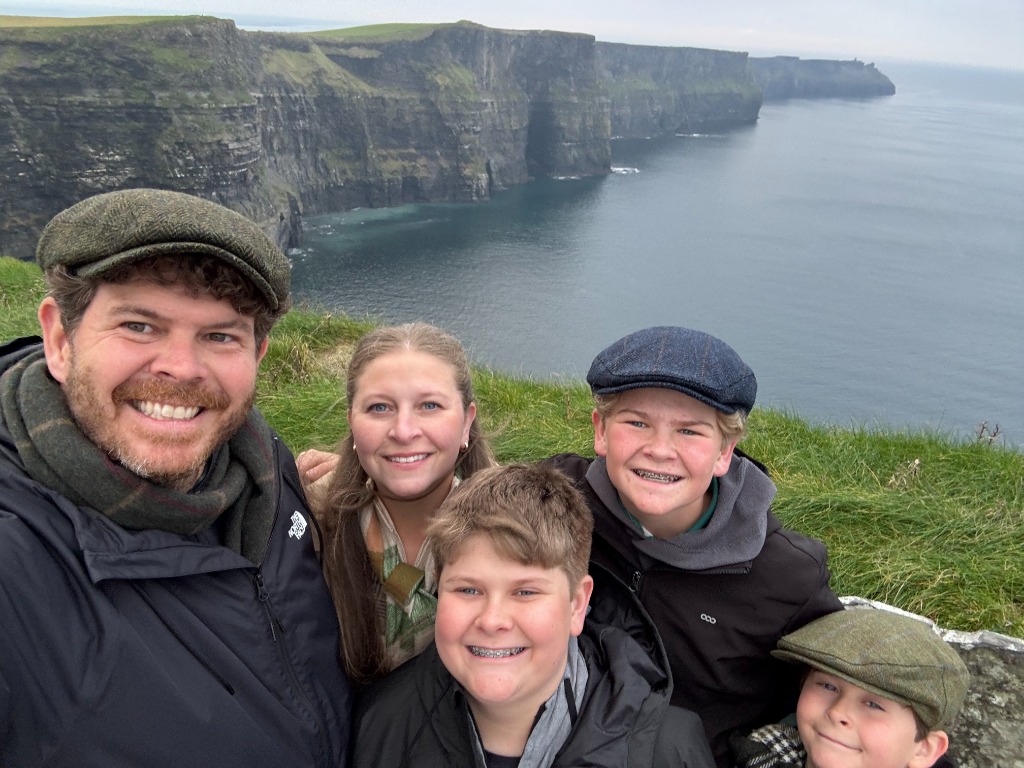
At the end of the day, my primary role and greatest focus is at home. I am a husband, a father to three active boys, and hopefully a decent human being striving to leave the world a little better than I found it. Everything else—the startups, the living labs, the mentoring—is built on this foundation.