I spent $7,787, had 146 Messenger conversations, sold six World Cup tickets for $13,200, and learned what AI still can’t do.
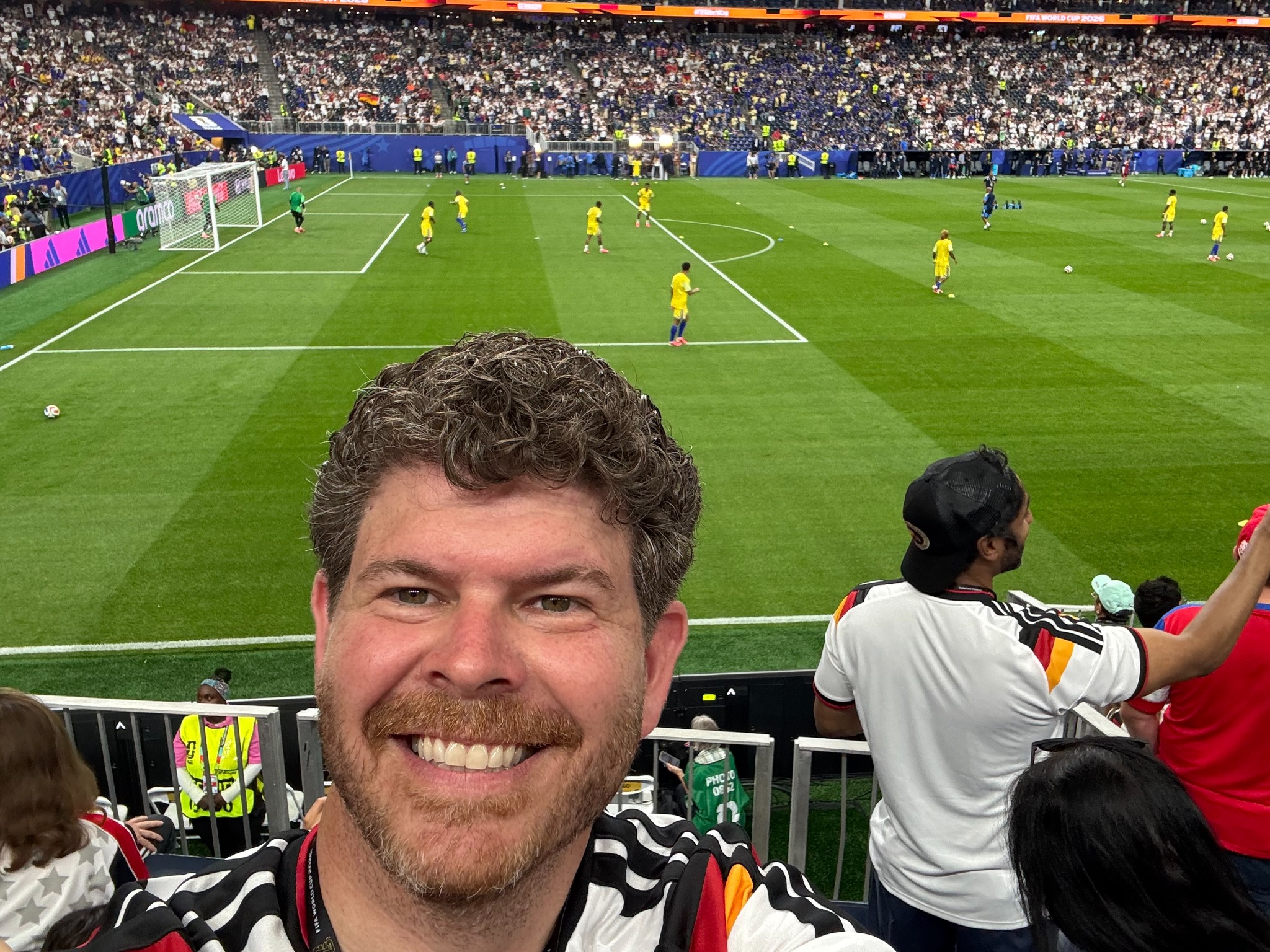
At the Germany vs. Curaçao match in Houston. This photo later became part of how I showed buyers I was a real local seller and fan.
I was sitting in a restaurant parking lot in The Woodlands trying to complete a $6,000 World Cup ticket sale with a stranger.
The buyer wanted the tickets. I wanted the money. Neither of us wanted to get scammed. His bank was blocking the transfer. We were both trying to be careful without making the other person feel accused.
I had used AI to understand the market, price the tickets, draft messages, compare comps and avoid what looked like a possible scam. But in that moment, AI was not going to close the deal.
The deal was going to close only if two people in a Houston-area parking lot could create enough trust to move forward.
That was not how this started.
I live north of Houston, and when the World Cup came to Houston, I wanted to take my family to a match. I had never attended a World Cup game. I had never bought or sold tickets for profit. I was not trying to become a ticket reseller. I was a dad trying to get six seats together for a once-in-a-lifetime family experience.
The ticketing process was confusing, so I did what more and more people do now: I asked AI.
It helped me understand FIFA Collect, Right-to-Buy collectibles, Right-to-Ticket mechanics and the different paths someone might use to get access to Houston matches. It warned me that these collectibles were not the same as tickets. They were a gamble: a way to get access, not a guarantee of the perfect match or perfect seats.
I bought in.
On Sept. 20, 2025, in the rush of trying to secure a path to enough Houston tickets for my whole family, I spent $2,387 on Right-to-Buy collectibles. Two months later, on Nov. 21, another deadline arrived: I had to decide whether to convert those rights into actual ticket access. In the moment, I decided to go for the best seats I could get — Category 1 — and spent another $5,400.
That is how the total reached $7,787. Not through one grand plan, but through a series of urgent decisions that each felt reasonable at the time.
And I had not fully talked that through with my wife.
That part matters. This is not just an “AI helped me make money” story. For months, this created real tension at home. My wife worried I had taken a reckless risk. She did not think I would get the money back. And she was not wrong to be worried.
A good outcome does not automatically justify a bad process.
Eventually, I got the six tickets I needed. My family went to Germany vs. Curaçao in Houston, and the experience was incredible. Our seats were better than I expected. My kids, who had not cared much about soccer before, suddenly cared. We started watching games together every day. They kicked a soccer ball around the house and backyard. They played FIFA on Xbox.
But I still had six extra tickets to three other Houston matches.
Then the panic started.
I had converted my Right-to-Ticket collectibles into actual tickets. Once I did that, I could not list them the way I expected on the FIFA Collect marketplace. The resale path I expected was gone. Meanwhile, the tickets were not fully available until close to the matches. I had thousands of dollars tied up, travel plans that meant I could not attend the other games, and a clock that was moving fast.
So I went back to AI.
I asked where to sell. I asked when to sell. I asked how much to charge. I uploaded pricing comps from FIFA and StubHub. AI helped me think through scenarios: Portugal demand because fans wanted a chance to see Ronaldo, a Houston knockout match that could become valuable if Brazil landed there, a July 4 Round of 16 match that might become one of the hottest tickets in town.
It was useful. Very useful.
But eventually I realized I was asking AI the same questions over and over. The answers were getting better, but I was not getting closer to a buyer.
I was using AI to delay the uncomfortable work.
So I entered the actual Houston ticket market.
My first serious Facebook interaction almost pulled me in the wrong direction.
An admin from one of the larger World Cup ticket groups reached out and offered to help broker a package deal for all three pairs of tickets. On paper, it sounded perfect. He said he could sell the full package for $11,000, send me $10,000 and keep $1,000 as his commission.
At that moment, I was nervous about whether I could sell anything. I had thousands of dollars tied up, matches approaching quickly and no clear resale path. So the offer was tempting. It seemed like someone else could take the whole problem off my hands.
But then the process started to make me uncomfortable. Instead of a clean buyer-pays-first structure, he focused on my most valuable Round of 16 tickets and wanted me to transfer them before I had received any money.
Maybe it was legitimate. Maybe it wasn’t. I still don’t know. But the risk was asymmetric. Once I transferred the tickets, I had no practical way to get them back.
I asked AI to help me think through the red flags, but the decision came down to a simple rule: I would not transfer tickets before confirmed payment. I offered a safer structure: the buyer could pay me directly for one pair, I would confirm the funds, transfer the tickets through the official FIFA app, then repeat the process and pay the broker his commission.
The deal went nowhere.
That was probably the most valuable sale I did not make. It taught me that when a shortcut seems to remove all the hard work, it may also remove all your protection. I could not outsource trust. I had to create it myself.
So I joined Facebook groups full of people looking for World Cup tickets. Some had a few hundred members. Some had tens of thousands. I posted. I searched for buyers looking for the exact matches I had. I replied to comments. I answered direct messages. I explained the confusing FIFA Collect story over and over.
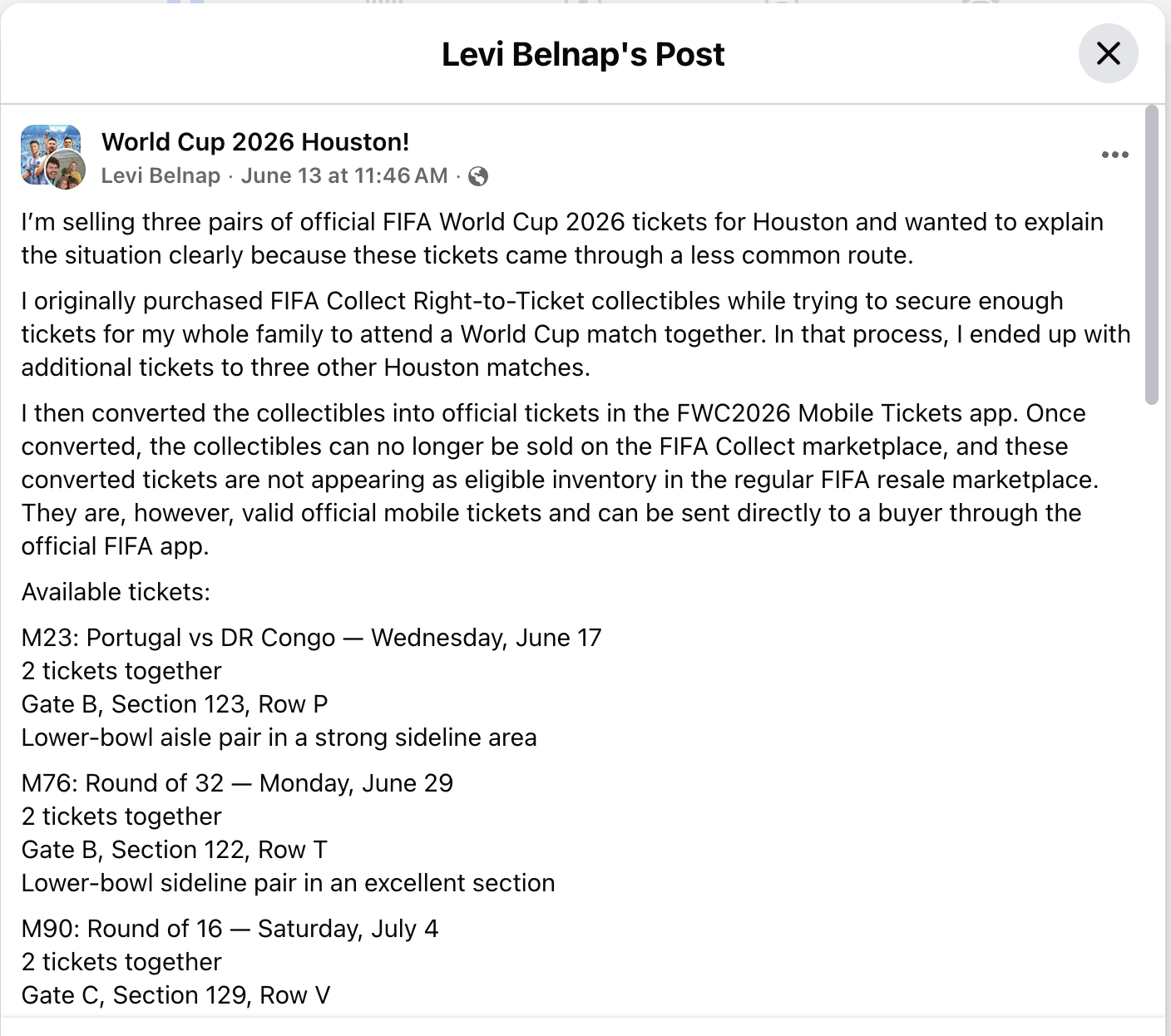
My early Facebook post was mostly education: explaining why I had the tickets, why they were real, and why the transaction path was unusual.
At first, I thought my problem was price. It wasn’t. My first problem was trust. My second problem was education.
People did not just need to know what the tickets cost. They needed to understand why I had them, why they were real, why they could not be listed in the normal place I had expected, and why buying from me would not get them scammed.
AI helped me turn that messy explanation into clearer posts and messages. But it did not do the selling.
By the end, I had 146 Messenger conversations.
Three turned into sales.
That number is the part people miss when they talk about AI making things easy. AI compressed the learning curve. It did not eliminate the sales cycle.
The first sale was for Portugal tickets. The buyer reached out and asked if I still had them. By then I had learned that interest was not the hard part. Trust was. So I offered to do the transaction live over FaceTime. I sent my LinkedIn profile. I made myself visible because in a market full of scams, reputation becomes part of the payment infrastructure.
That pair sold for $2,200.
That first sale changed everything. Before that, I had theory, comps, AI analysis, posts and lots of messages. After that, I had proof that the market was real and a transaction model that worked: make myself visible, verify the tickets live, confirm payment, transfer through the official FIFA app and make sure the buyer received them.
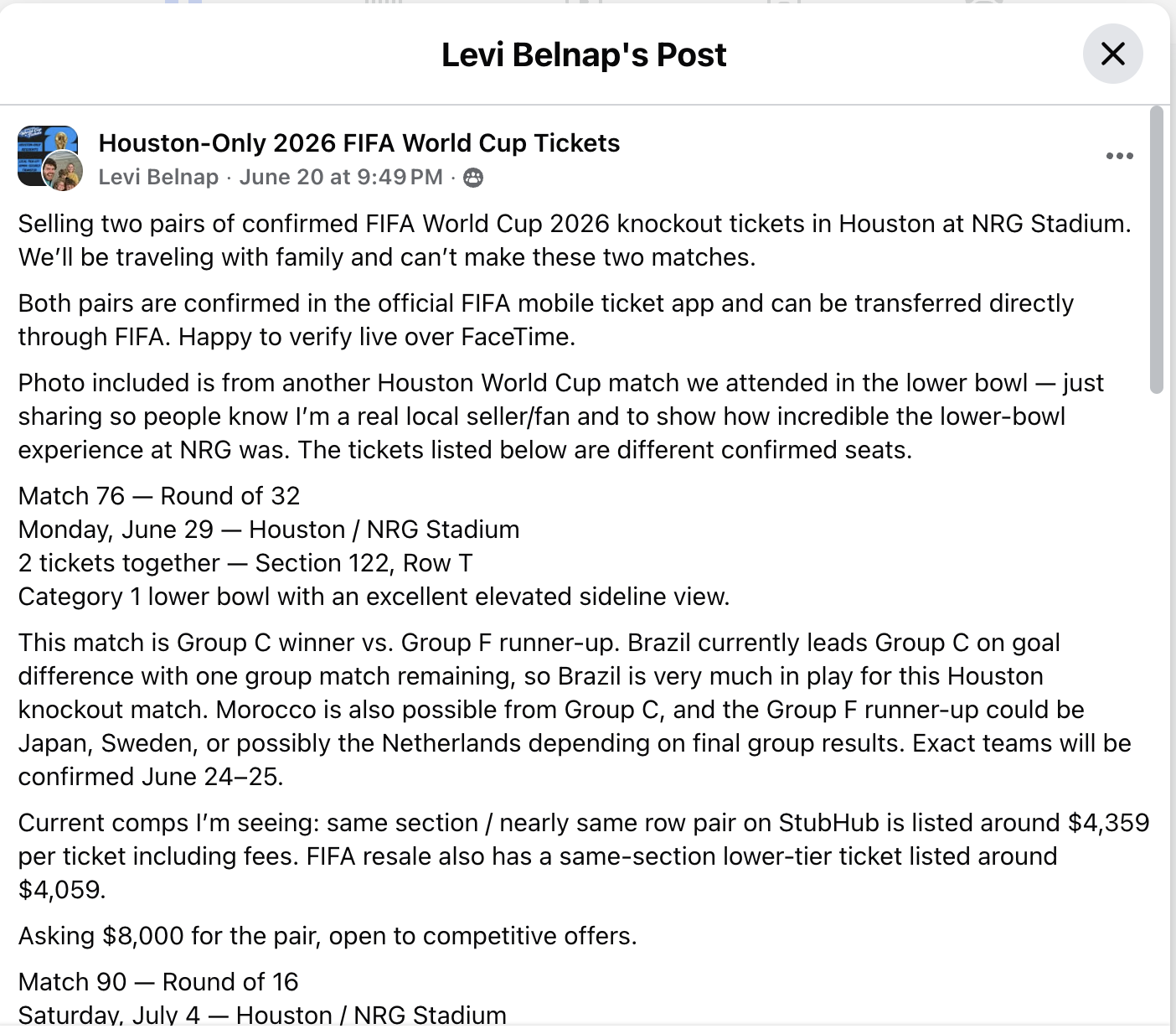
Later, the posts became more sophisticated: current comps, price anchors, live verification, and clearer trust signals.
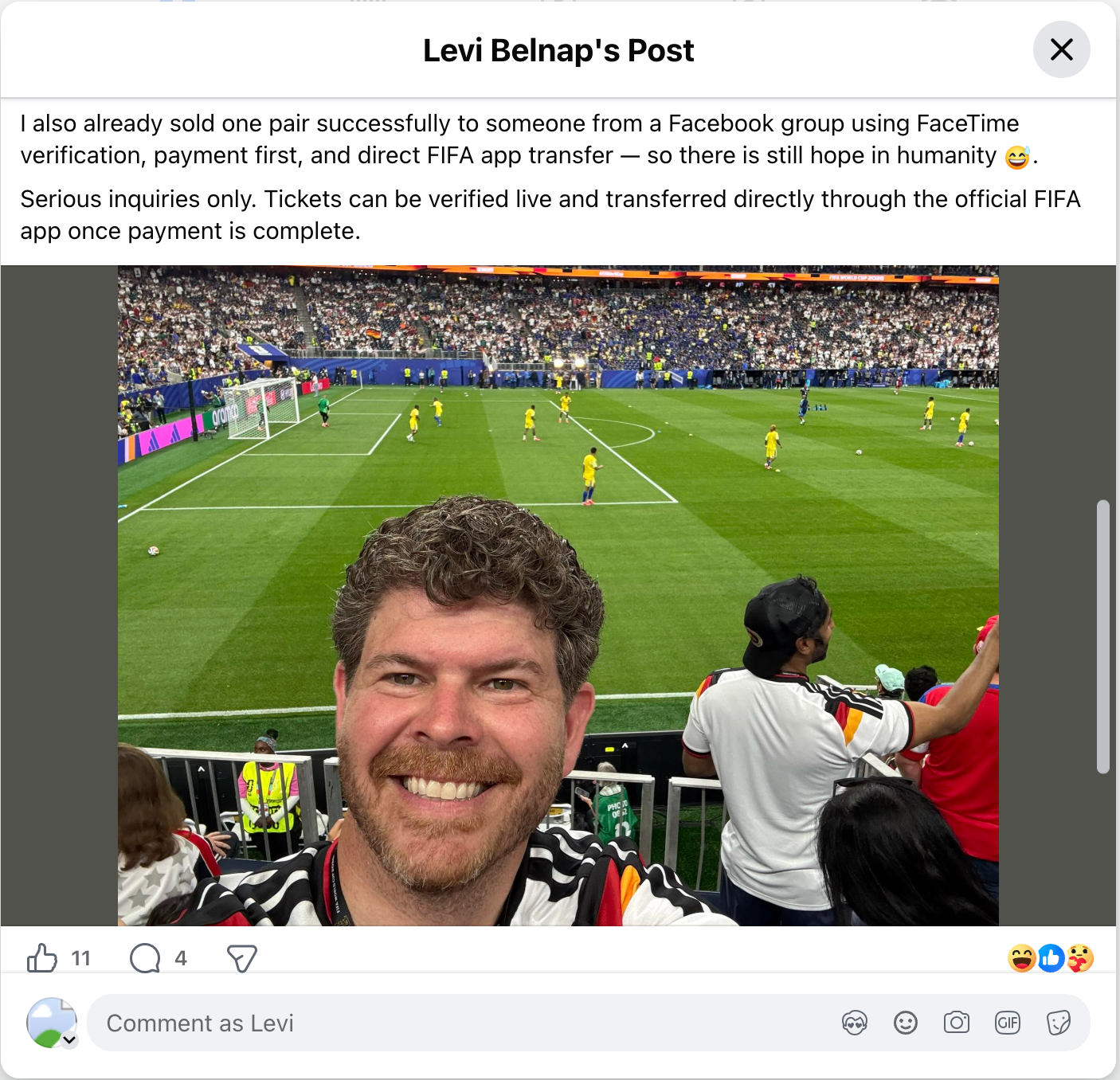
The photo from the match became part of the trust-building strategy.
The second sale taught me another lesson: posting is not selling.
I saw someone looking for a Houston knockout match I had. He did not come to me. I went to him. At first, it was messy. There was hesitation, coordination over payment and the usual fear on both sides. I held the ticket while they figured it out. At one point, I was literally pulling off the freeway so I could safely send the ticket.
That pair sold for $5,000.
The third sale was the parking lot deal.
The buyer wanted the Round of 16 tickets, but for $6,000 he understandably did not want to do the whole thing over Facebook messages. So we met in person. It took longer than expected. The bank blocked the transfer. We waited. Eventually, the money went through and I transferred the tickets.
That night, he messaged me: “Thank you so much. Made my parents’ day today.”
That line changed how I felt about the sale. Yes, I had made money. But I had also gotten the tickets to someone who really wanted them.
The market kept moving even after the tickets were gone.
A few days later, I watched the tournament finish writing the story in real time. Brazil beat Japan in the final seconds of added time in the Round of 32 — the exact match I had sold tickets to. Germany, the team my kids and I had watched in Houston, lost to Paraguay in a penalty shootout. Then Morocco beat the Netherlands in another penalty-kick roller coaster, setting up Canada vs. Morocco in Houston on July 4 for the Round of 16 tickets I had sold in that parking lot.
Every result reminded me why the tickets had been so hard to price. The value was changing with the tournament itself.
In total, I sold six tickets for $13,200:
| Ticket pair | Sale price |
|---|---|
| Portugal pair | $2,200 |
| Houston Round of 32 pair | $5,000 |
| Houston Round of 16 pair | $6,000 |
| Total resale revenue | $13,200 |
That covered the full $7,787 cost of all twelve tickets and left us with $5,413 in profit. My family attended a lower-bowl World Cup match in Houston, and the resale proceeds paid for the whole experiment.
As the sales became real, my wife and I agreed that any profit would go toward new carpet for the house, something she had wanted for years. That changed the emotional tone. It was no longer just me trying to prove I had not made a mistake. It became a practical family goal.
By the end, she forgave me. She even admitted, with some reluctance, that maybe I had been right about the market.
But the more honest conclusion is that we were both right.
I was right that there was a market. She was right that I had taken a real risk without fully bringing her into the decision.
One of the unexpected gifts was bringing my kids into the process.
I have always looked for ways to give them real-world opportunities to buy, sell, negotiate and learn human skills. We have done that with Pokémon, One Piece and sports cards. Watching my eight-year-old confidently negotiate hundred-dollar card deals with grown men at card shows has become one of my stranger points of pride as a dad.
This World Cup experience became a much bigger version of that lesson.
My kids watched me evaluate offers, think through pricing, avoid a questionable broker, decide when to hold firm, decide when to close and celebrate when the deals got done.
They also watched me make mistakes. They watched me feel stress. They watched me deal with the consequences of a risk that affected our family. That part matters too.
I spend my days at Texas A&M’s Mays Business School helping student entrepreneurs learn how to use AI to test faster, learn faster and pursue opportunities they might not have had the confidence to try before. But the lesson I keep coming back to is that you learn by doing, not by talking about doing.
You test. You reflect. You share honestly what happened. Then you run the next experiment better.
That is what this became for me: a small Houston market experiment, powered partly by AI and finished by human work.
For a few weeks, Houston was not just hosting World Cup matches. It was hosting a live experiment in markets and trust. Fans were chasing tickets. Sellers were trying to prove they were real. Prices moved with every goal, upset and penalty kick. Strangers negotiated through Facebook messages, screenshots, payment apps, FaceTime calls and parking-lot meetings.
AI helped me understand that market faster. But it could not do the human work required to participate in it.
AI helped me understand a market I did not know. It helped me evaluate prices, draft messages, compare comps and identify red flags. It helped me move faster than I would have moved alone.
But the most important parts were still deeply human.
AI could not build trust with a stranger on FaceTime. It could not sit in a Woodlands parking lot while a bank blocked a $6,000 transfer. It could not repair the tension I created at home. It could not teach my kids what it feels like to ask for the sale.
And it could not replace the discipline of doing the work most people avoid.
AI will help people understand confusing systems, compare options and make decisions faster.
But it does not eliminate the need for courage, judgment, persistence and trust.
In the end, that is where the real work happened.