We treat the future (whether in sports, technology, or our careers) as if it is pre-written. But progress isn't a natural law. It is the active exploitation of happy accidents.

Lionel Messi making the decisive pass against England in the World Cup Semifinal. (Photo courtesy of The Guardian)
I. The 92nd Minute in the World Cup Semifinal
Last night, I walked out of a meeting and pulled out my phone to check the score of the World Cup Semifinal. Argentina against England.
I couldn't believe my eyes when I saw the result.
Later that evening, I sat down to watch the recording of the match. For 85 minutes, the story of the game was already written. England was up 1-0. They had retreated into their penalty box, playing defensive lockdown, suffocating the clock. To any casual observer, Argentina’s exit from the tournament seemed pre-determined.
But sports have a way of shattering inevitability.
In the 85th minute, Argentina clawed one back to draw even. And then, in the 92nd minute, Lionel Messi did what he has done his entire career. He received the ball on the wing, cut back, danced past two defenders with just enough space to breathe, and lofted a perfect cross across the goal. His teammate met it with a clean header.
Game over. Argentina was going to the World Cup Final.

Lionel Messi juking two England defenders in the 92nd minute to set up the winning cross. (Watch the clip: Messi's 92nd-minute assist against England)
After the whistle blows, we start writing the narrative of inevitability. We deify the athletes. We act as if Messi and Argentina are so dominant that they had to win, that no one could stop them.
But it’s a lie. It didn't have to be that way. In the moment Messi had an opportunity, he did something about it. He found the energy to cut back hard despite being tired and created just enough separation. His teammate fought for position and was able to get his head on the ball. It wasn't predestined. They took advantage of the moment, all the preparation that went before it, and all the luck throughout the game. It didn't have to be that way.
II. The Fossil Fuel of the AI Revolution
This illusion of inevitability is the dominant myth of our technological era.
When we look at the rapid rise of Generative AI, LLMs, and conversational computing, we treat it like a natural law of physics. We act as if this intelligence was always bound to emerge exactly when and how it did.
But in Chapter 13 of The Infinity Machine, titled "On Language and Nature", Sebastian Mallaby describes how co-founder Demis Hassabis and the DeepMind team encountered a lucky convergence they never could have engineered.

Demis Hassabis, co-founder and CEO of Google DeepMind and co-winner of the 2024 Nobel Prize in Chemistry. (Photo courtesy of Britannica)
Hassabis points out that we didn't plan for this moment. Instead, we woke up one day and realized we had a massive, pre-existing resource lying around: the digitized internet.
In Chapter 13, this is framed through a powerful historical analogy: the internet was to AI what coal and oil were to the Industrial Revolution.
That prehistoric fuel was only lying beneath the earth because of the unfortunate demise of dinosaurs millions of years before. The early industrialists certainly didn't plan for that. And in another example of how we retrospectively rewrite the narrative to make things look pre-destined, oil had been sitting in the ground for millennia. But it wasn't until the Industrial Revolution that the right confluence of factors enabled it to fuel progress in ways nobody could have predicted. The people who leaned in and acted benefited. But it didn't have to be that way.
The same thing was true of the internet and the massive pool of language data we accumulated. Demis and his team at DeepMind didn't originally believe that the raw text on the internet (the language captured from our species) was rich enough to represent the complexity of human intelligence. You could have fed all of that data into transformers and ended up with garbage. It could have been useless noise. It didn't have to work.
It was an incredible stroke of luck that this messy, organic web data was representative enough of human knowledge and intelligence that it could successfully train AI and lead to unforeseen progress so quickly. Even Demis and his team were surprised by how well it performed. (Watch: Demis’s acknowledgement of getting surprised, not knowing everything, but taking action to build the future). It didn't have to be that way.
Having the raw coal lying around doesn't build the steam engine. OpenAI realized it first and took the lead because they saw an opportunity in the internet's data and transformers and large language models where others didn't. It wasn't predestined. OpenAI made it that way. It didn't have to be that way. DeepMind and others had the same raw elements, but it was the choice to lean in and act that changed the physics of the industry.
III. The Steve Jobs Paradigm
This connects back to a famous observation made by Steve Jobs during his Stanford Commencement address:
"When you grow up, you tend to get told that the world is the way it is... Life can be much broader once you discover one simple fact: Everything around you that you call life was made up by people that were no smarter than you. And you can change it, you can influence it... once you learn that, you'll never be the same again."
We let ourselves off the hook by believing in inevitability.
If we believe AI is inevitably going to take all the jobs, or that startup outcomes are predetermined by market forces, we become passive observers. We sit in the stands and watch the game happen to us.
But the world is malleable, and progress is highly contingent on luck and timing. We cannot control when the coal and oil are formed, but we can control whether we build the engine. We cannot control when the ball bounces to our wing, but we can control whether we run the route.
IV. The Living Lab: Texas A&M
I see this truth clearly in the history of the institution where I now serve.
Today, Texas A&M University is a massive force in the heart of the world's eighth-largest economy, educating over 80,000 students. We talk about its scale as if it’s a permanent monument.
But 150 years ago, Texas A&M started in a rural field with exactly six students.
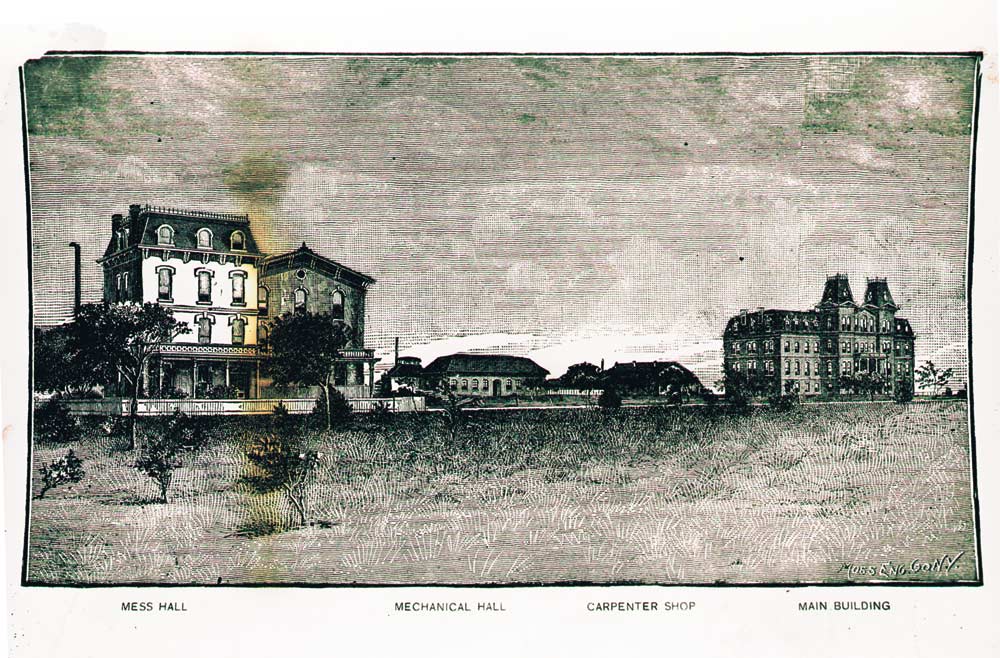
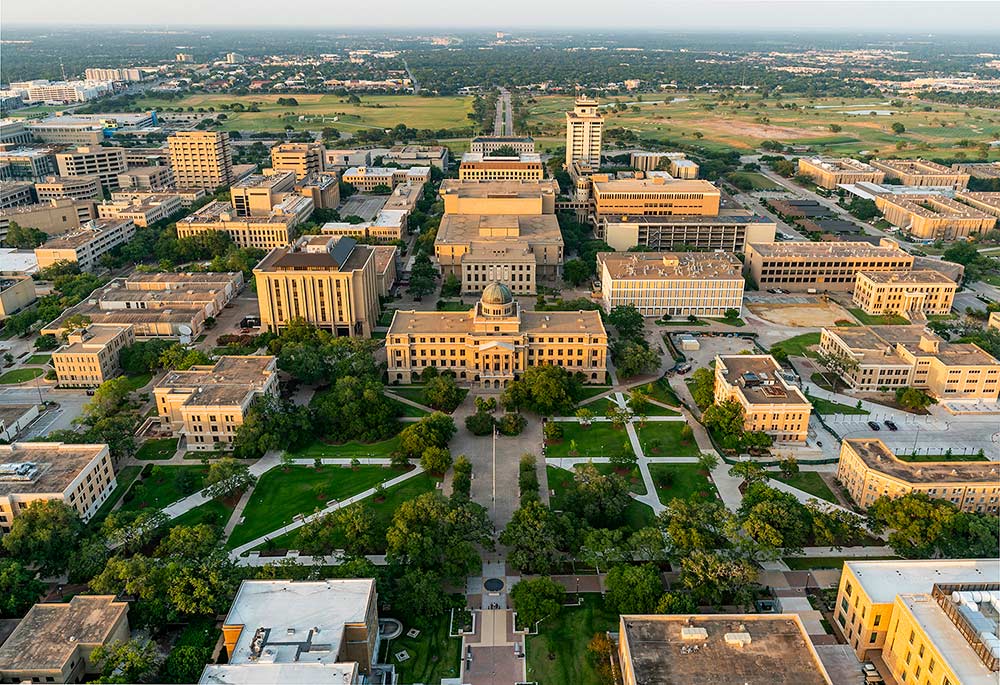
Texas A&M's trajectory: from a historic drawing of its early campus (top) to the modern aerial landscape at sunset (bottom). (Images courtesy of Texas A&M University)
It didn’t have to become this giant engine of opportunity. It happened because generations of Aggies made active choices, took risks, built buildings, and did the hard work. And we are still shaping it today. Under the leadership of our new president, Dr. Susan Ballabina, we are actively deciding what the next chapter of this living laboratory looks like.
We see this same pattern in agriculture. We look at modern high-yield crop production and take global food supply for granted. But it was shaped by people like Nobel laureate Norman Borlaug, whose pioneering agricultural research saved over a billion lives from starvation.
While Borlaug's historic Nobel-winning work breeding high-yield wheat varieties was done in Mexico, he later brought that legacy to College Station, establishing the Borlaug Institute at Texas A&M. He recognized the coincidence of genetics and climate, but it was his active, grinding choices that got the seed planted where it was needed most.
Today, Dr. Elsa Murano (former A&M president) carries that legacy forward as Director of the Borlaug Institute, constantly choosing to apply research to solve hunger in developing nations.
I recently visited with Dr. Elsa Murano at the Borlaug Institute and walked away amazed and inspired. The sheer global scale and impact of the mission they have had (and continue to have) on the world is a testament to the power of human choice over inevitability.

A recent visit with Dr. Elsa Murano at the Borlaug Institute, witnessing their ongoing global mission first-hand.
During my visit, I saw a banner with a quote from Norman Borlaug that fits this theme of inevitability perfectly: "The fear of change is an obstacle to progress."
It is a reminder that we cannot let fear lock us into believing the current state of things is permanent. You can create the change you wish to see in the world. Don't be afraid. Go do it.
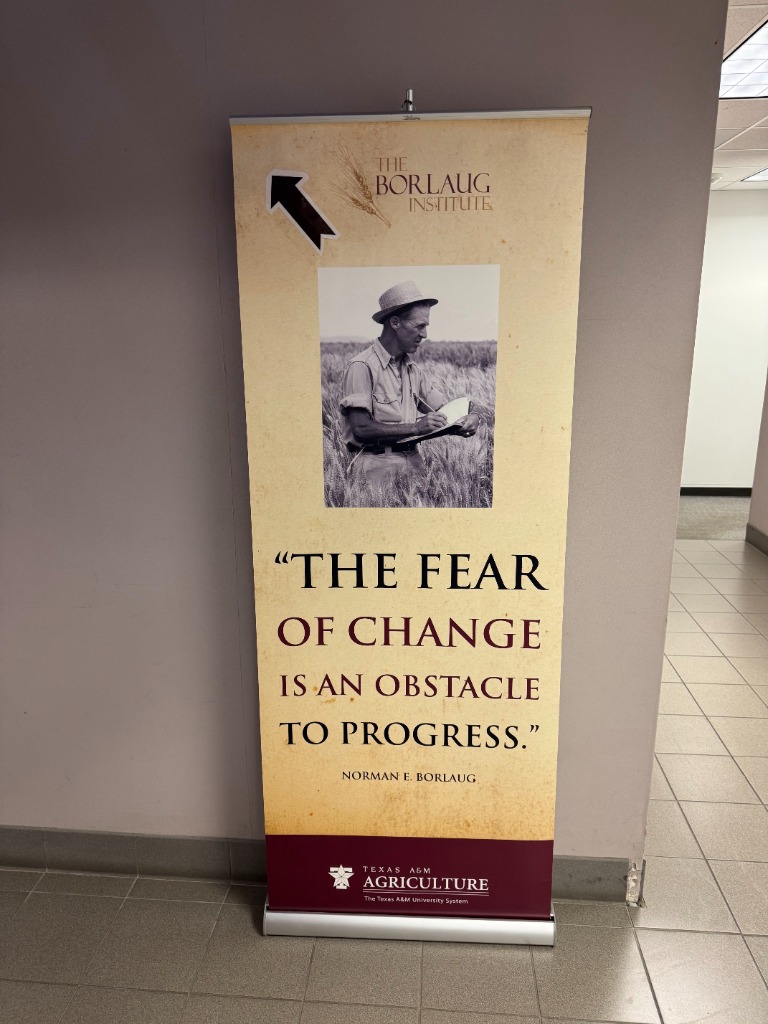
A banner at the Borlaug Institute: "The fear of change is an obstacle to progress."
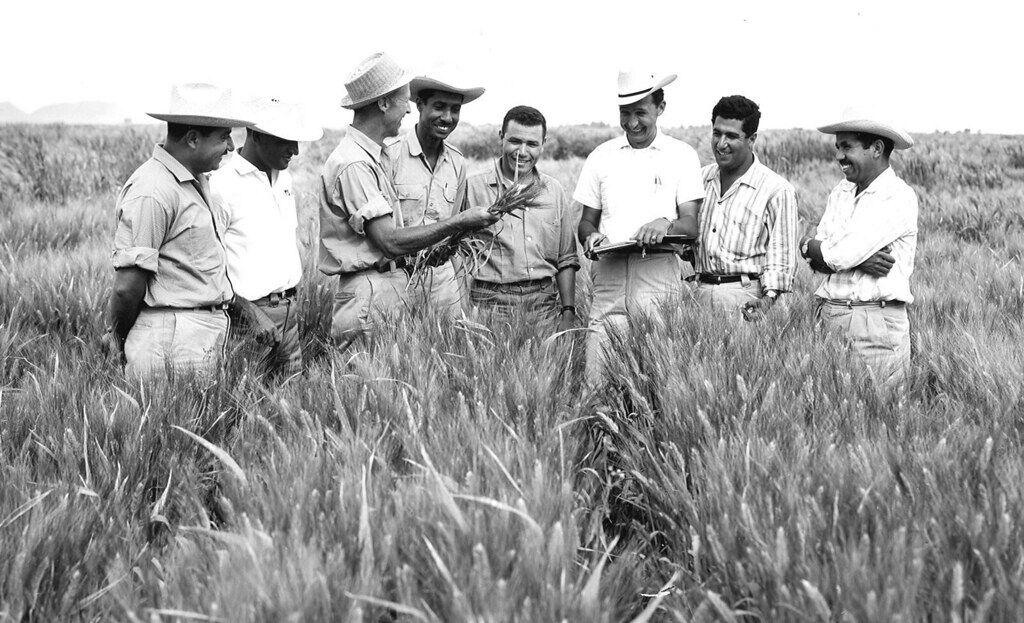
Dr. Norman Borlaug teaching a group of young scientists. (Photo courtesy of The Battalion)
Norman Borlaug was one agronomist who made a choice to solve a problem most people thought was unsolvable. He changed the physics of global agriculture because he refused to accept starvation as inevitable.
V. Reclaiming Your Agency in the Age of Luck
This is the core doctrine we teach at the Center for Applied Entrepreneurship & Innovation (CAEI).
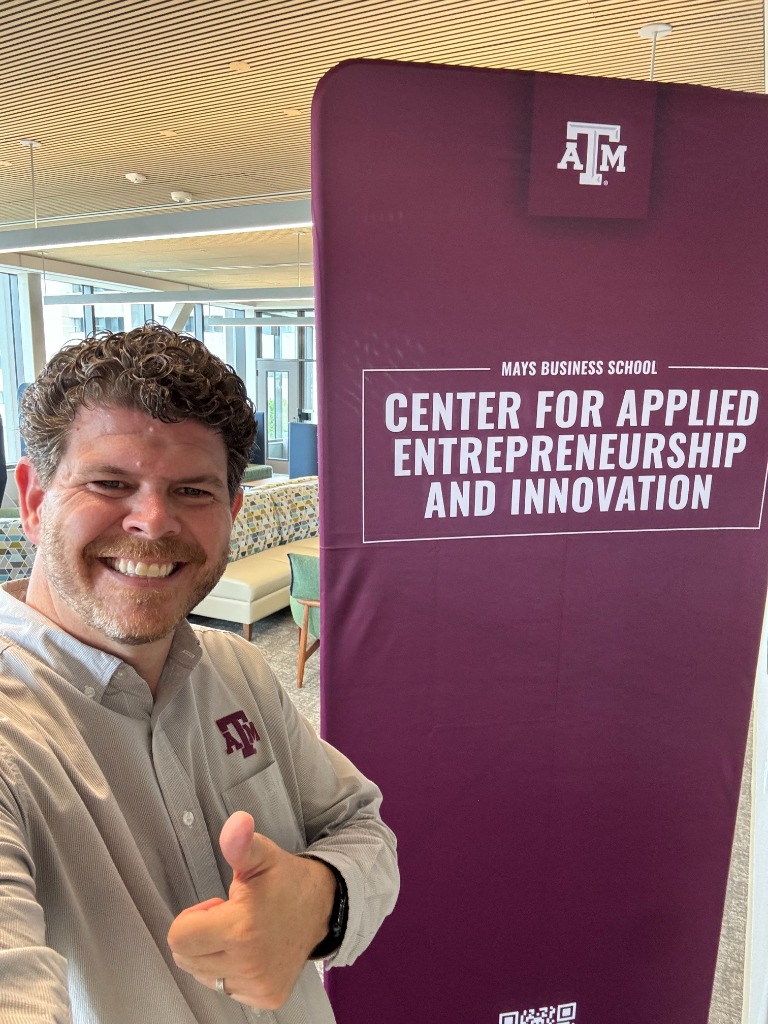
Supporting student entrepreneurs at the Center for Applied Entrepreneurship and Innovation at Mays Business School.
We tell our student entrepreneurs that they are living in a moment of historic, unearned luck. They did not invent LLMs, and they did not build the cloud servers. But they happen to be sitting right at the intersection of a historic coincidence: execution costs have collapsed to near zero, and the raw fuel of the digital age is ready to be burned.
The question is: will they sit back and let the wave wash over them, or will they build the engine?
When you look at your company, your community, your family, or your career:
- The current problems do not have to persist.
- The market does not have to stay the same.
- The way we work does not have to be locked in.
We cannot engineer the luck, but we are fully responsible for what we do with it. Reclaim your agency. The future isn't happening to you; you are making it happen.
Go make it.
I can't wait to see what happens between Argentina and Spain in the World Cup final. It's not predetermined. That's what makes it such a beautiful game. And that's what makes life such a beautiful adventure.