Before reading this post, I highly suggest queueing up Weezer’s new single C.E.O. to set the mood. You can listen to it on your preferred streaming service via their official smartlink.
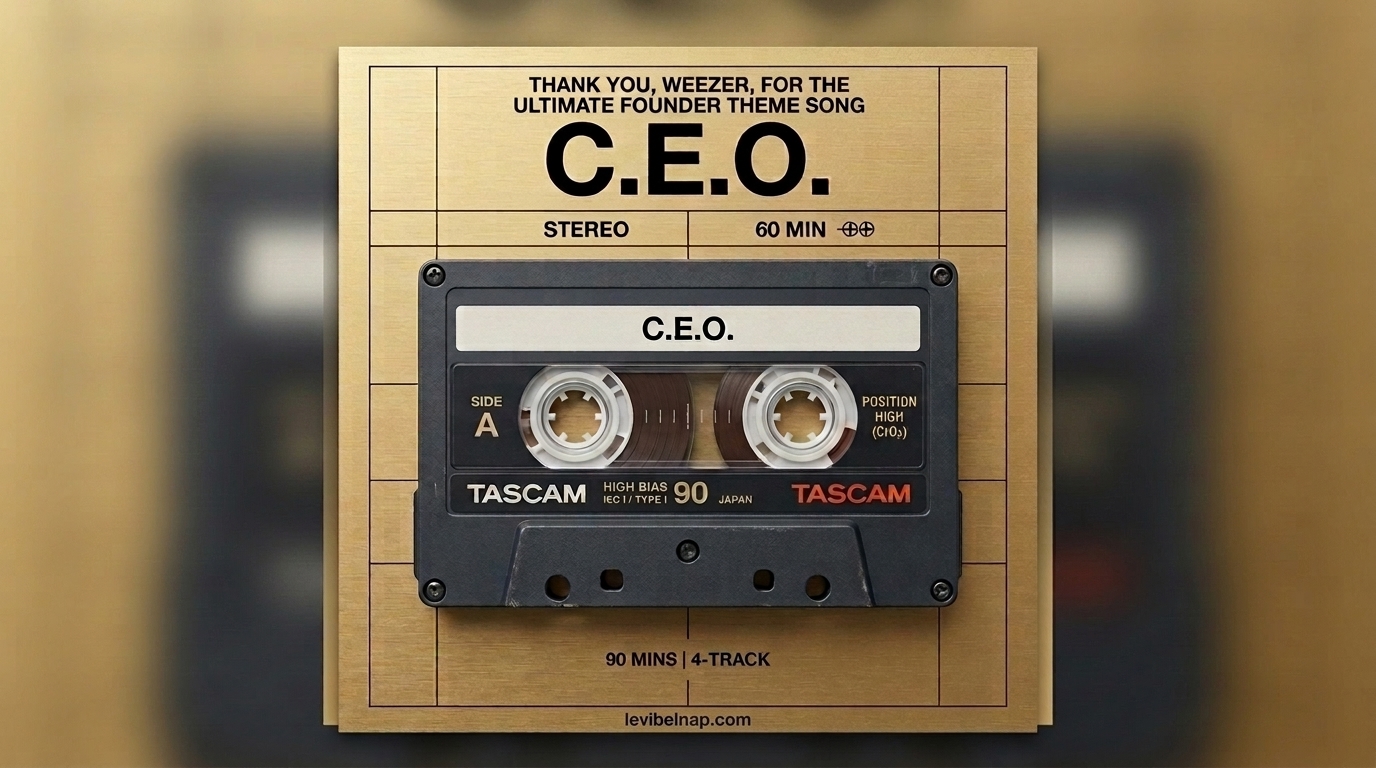
Thank you, Rivers Cuomo, for finally writing the official walk-up theme song for founders, CEOs, and entrepreneurs.
If you haven’t heard Weezer’s new single C.E.O. yet, it is a brilliant, self-aware meta-commentary on the realities of a three-decade music career. The song is a direct musical callback to their 1994 classic Undone (The Sweater Song), right down to a music video that parodies the original blue backdrop with a shiny gold one.
But the real magic is in the lyrics. Rivers Cuomo sings openly about the friction of wanting to explore new creative directions, only to be pulled back by his market:
“Cranking out another 90s jam Wish I could do something new But nobody wants to hear that They just want the classics... I've gotta grow up and be a real adult Stop complaining and give the people what they want”
For Cuomo, the transition is clear: he has to stop thinking like a "mad professor" tinkering with a Tascam tape deck in his cocoon, and start thinking like a "C.E.O." whose job is to keep the rocket in the sky.
It is a funny, slightly tragic, and deeply true metaphor for the transition every successful founder must make.
"Because I Want to Tell People What to Do"
This week was the first week of classes at Texas A&M University. On Friday, I had the privilege of welcoming incoming freshmen, spending hours at a table talking to students about how the Center for Applied Entrepreneurship & Innovation can help them test entrepreneurial pathways, run experiments, and get repetitions.
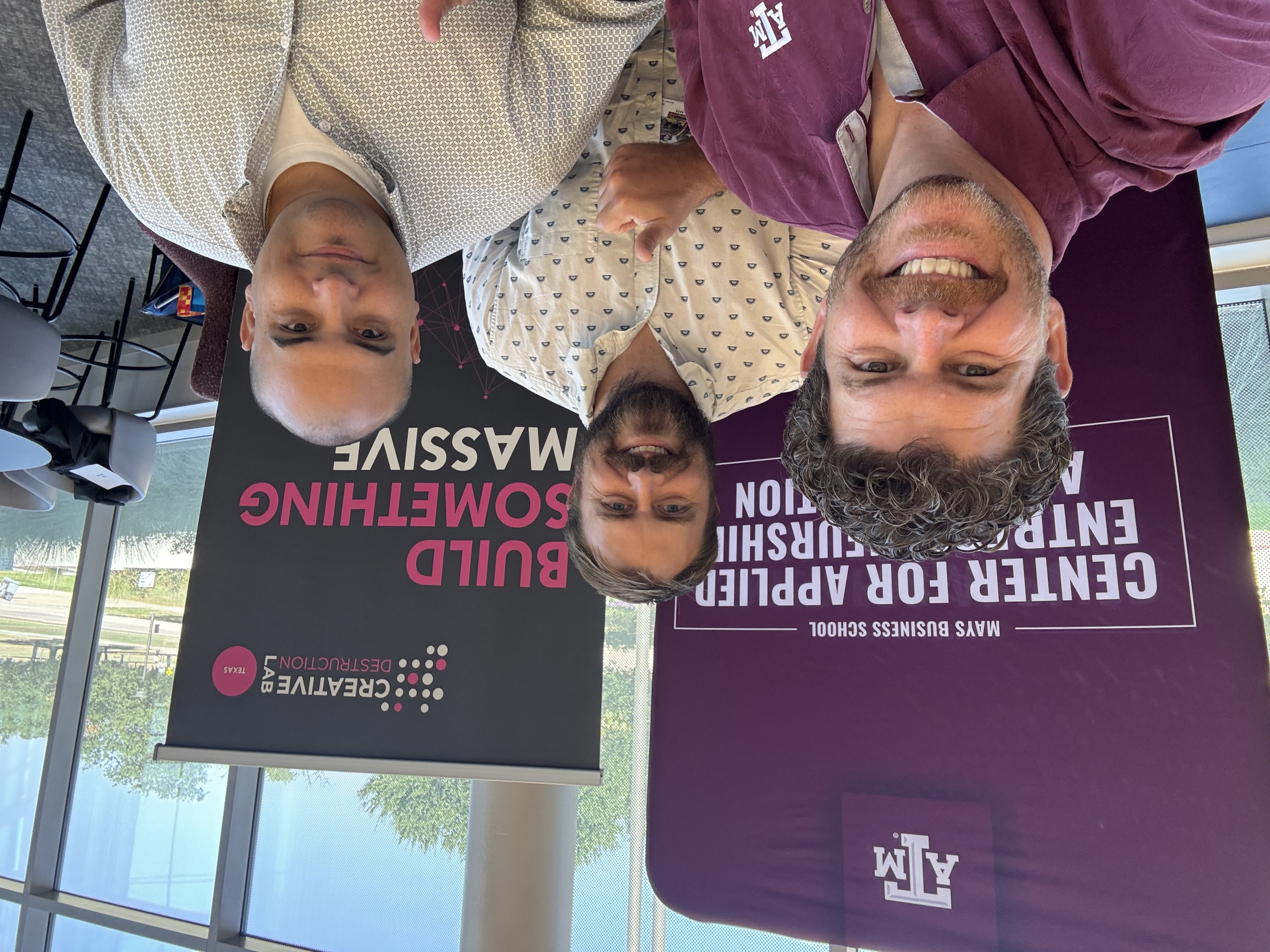
Welcoming incoming freshmen at the Center for Applied Entrepreneurship & Innovation table during the first week of classes at Mays Business School.
I kept asking the students a simple question: "Why are you interested in entrepreneurship?"
Many of them didn't have a clear answer yet, which is completely natural. But one student was exceptionally confident.
"Because I like to tell people what to do," she said. "I want to be the boss, and I want to tell people what to do."
I laughed, because she voiced the exact illusion that draws so many of us to entrepreneurship. We want to be the boss. We want to be in control.
But as we talked, I shared the reality: yes, you get to give direction, but you quickly find that you are often directing your team to do things you didn't personally want to do, all in service of what the business actually needs.
My advice to her was to shift her focus: "Love a problem. Find a problem that needs to be solved and understand the market. When you do that, the guidance and instruction you give your team will be rooted in market physics, which is the only way to build real success."
The Illusion of Founder Freedom
It is a weird, delicate balance: you must have enough ego and confidence to believe you can challenge the status quo and build something new, while simultaneously having the humility to check your ego at the door and submit your ideas to what the market actually needs.
When early-stage entrepreneurs set out to build a company, they often believe that becoming the CEO means absolute freedom. They think it means they get to make all the rules, build whatever their heart desires, and bend the market to their personal vision.
In reality, the exact opposite is true.
Being a CEO is not about doing whatever you want. It is about putting your personal interests, your ego, and your creative agenda aside to serve the good of the entity and the demands of the market. You don’t bend the world to your will; you bend your will to the physics of the world.
The Physics of the Market
In entrepreneurship, you cannot fight the physics of the market.
If the market demands a "90s jam" (a specific, high-value product-market fit), your job as the CEO is to build it and deliver it better than anyone else. Continuing to act like a mad professor in a cocoon (building features or exploring directions that only interest you) is a guaranteed way to crash the rocket.
The best founders learn this early. They identify a real market, understand exactly what those customers want, and ruthlessly align their execution to deliver it.
This transition comes with a certain creative sacrifice. There is a quiet sadness in putting away the freedom of pure exploration to focus on structured delivery. But for the CEO, the ultimate goal is not self-expression; it is keeping the rocket flying. And as Weezer shows us, you can still find immense joy and rhythm in keeping that rocket in the sky.
(Watch: the official music video for C.E.O. on YouTube)
(For comparison, watch the original 1994 music video for Undone (The Sweater Song) on YouTube to see the shot-for-shot gold-vs-blue parody.)
Weezer: "C.E.O." Lyrics
Cranking out another 90s jam
Wish I could do something new
But nobody wants to hear that
They just want the classics
You can't blame them, really
There's something special about your early shit

I've gotta grow up and be a real adult
Stop complaining and give the people what they want (What they want!)

Here comes the C.E.O.
I’ve gotta keep this rocket in the sky
(Gotta keep this rocket in the sky)

You know, I was just a kid from Connecticut
Alone in my room, playing with a Tascam 688
I miss those days

I was happy tinkering in my room
All those hours chilling out in my cocoon

Here comes the C.E.O.
I’ve gotta keep this rocket in the sky (Gotta keep this rocket in the sky)
I've gotta stop thinking like a mad professor 'cause it's
It's getting me nowhere, it's getting me nowhere

Here comes the C.E.O.
I’ve gotta keep this rocket in the sky (Gotta keep this rocket in the sky)
I've gotta stop thinking like a mad professor 'cause it's
It's getting me nowhere, it's getting me nowhere

Here comes the founder and the C.E.O.
Whoa (Gotta keep this rocket in the sky)
I've gotta stop thinking like a mad professor 'cause it's
It's getting me nowhere, it's getting me nowhere